


How To Replace a Porch Light Fixture
Replacing a porch light fixture is not a difficult job and should take less than an hour for most DIYers. Changing the porch light style can have a large impact on look of your home. In the example below, the fixture we decided to remove was in perfectly good condition, but it didn't have the look we wanted. So we picked a Kichler Mission Style fixture to better match the style of the home. One thing to consider is whether to use a damp location rated fixture or a wet location rated fixture. Outdoor fixtures that will be exposed to the rain or water, require a wet location rating.
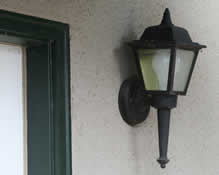 |
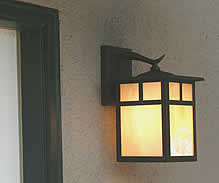 |
Old Light Fixture |
New Light Fixture |
Caution: Please read our safety information before attempting any testing or repairs.
Electrical work requires safe practices. Always turn off power at the circuit breaker or fuse box. Post a note that work is being done, to avoid someone turning the power back on. After turning off the power to the circuit, test the circuit to be certain that there is no power. Always use insulated tools for added safety. Check with your local building department for regulations and permit requirements before beginning work.
Start by turning off the power to the fixture at the circuit breaker. Turning off the switch is not safe enough, as was evidenced once when my 5 year old saw I was working on the light and he wanted to help me see better by turning on the light switch. Also, occasionally switches are miswired and while they will turn the light on and off, they do it by breaking the circuit after it goes through the fixture instead of before.
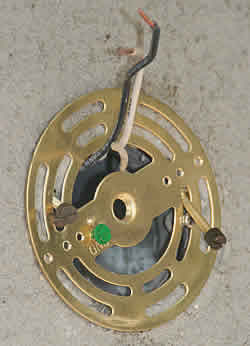 |
Turn the switch on to make certain the power is off, then turn the switch off again. Remove the screws or nuts that secure the fixture to the wall. Pull the fixture away and pull the wires out of the fixture box to expose the wire caps. While supporting the fixture, unscrew the wire caps and separate the wires.
If there isn't one already, install a fixture mounting plate or mounting strap. This is the metal piece that fastens to the fixture box with screws and then the fixture is fastened to mount with another set of screws. Pull the wires through one of the large openings before fastening it in place. Adjust the plate so that the screw holes align with the screws from the fixture when it is level and in its final position.
Some fixtures mount with the screws extending from the mounting plate. You place the fixture over the screws and then secure it in place with a nut. If this is the case, you must test fit the length of the screw as it extends outward. If it is too short, you will not be able fasten the nuts to secure the fixture, and if they are too long, they will not secure the fixture tightly to the wall.
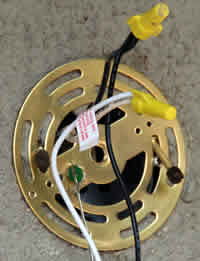 |
Next, wrap the ground wire clockwise once around the ground screw and tighten the screw. Now, twist the black wire extending from the fixture to the black wire extending from the wall. Twist on a wire cap until it is secure. If the cap can be pulled off with gentle force, it is either the wrong size or you have not twisted in on properly. Repeat these steps with the white wires.
Tuck the wires into the wall, leaving as little wire outside the box as possible. The wire caps should be tucked inside the wall. Lift the fixture into place and secure it with the mounting screws. Make certain all the wires are inside the fixture or fixture box and nothing is hanging outside the fixture. Tighten the screws and level the light fixture.
Install a light bulb, turn on the circuit breaker and then test the light fixture.
One note about installation a light fixture. Of all the light fixtures I have ever installed, in nearly every case, the screws or some part provided with the fixture did not fit. They were often the wrong size or sometimes I just dropped and lost the part. Therefore, to save yourself some aggravation, I recommend you buy some spare screws of varying lengths, matching sized nuts, a spare fixture plate, spare wire nuts and for certain fixtures an assortment of nipples. I replace fixtures often enough that I keep these parts on hand. If you are unlikely to need them after this project, leave them in their packages so that you can return any unused parts.


